Global banking is entering a new phase of growth. In 2025, the industry generated $1.3 trillion in net income, the highest of any industry worldwide, while banking balances grew to $406 trillion across deposits, loans, and assets under management. While strong profitability has changed the growth equation, growth is mostly coming from existing customers rather than new ones.
Customer behavior is evolving just as quickly. 88% of banking customers say the experience their bank delivers is as important as—or more important than—its products and services, making every interaction an opportunity to strengthen or weaken long-term customer value. At the same time, customers are increasingly evaluating multiple providers before opening new accounts or adopting new financial products, reducing the influence of traditional customer loyalty.
In this article, we'll look at the changes reshaping Customer Lifetime Value, and what they mean for customer intelligence, data architecture and the next generation of banking platforms.
The Data Gap Behind Customer Lifetime Value
The products customers buy may not have changed dramatically, but the way they discover, evaluate and purchase them has.
Banks are recording more customer activity than ever before. Every payment, card swipe, loan repayment, mobile login, service request and investment transaction adds another record. At the same time, customers are using more banks, fintechs and wealth platforms than they did a decade ago. Now, one bank can see years of account activity without seeing where a customer saves, borrows or invests elsewhere.
This makes Customer Lifetime Value more difficult, and more important, to understand. Knowing which products a customer owns today is no longer enough. Banks also need to understand how the relationship is changing, what the customer may need next and how likely they are to remain engaged over time.
This shift is also influencing enterprise data platforms. Banks are investing less in collecting customer information and more in connecting it. That explains why recent developments such as streaming pipelines, transactional Lakehouse databases and AI-ready data foundations have become central to banking technology conversations.
Customer Lifetime Value is therefore becoming more than a marketing metric or a retrospective measure of revenue. It is becoming an enterprise capability, one that depends on connected customer data, predictive intelligence and the ability to translate those insights into action across products and customer touchpoints.
The Loyalty Loop: The Primary Bank Knows Less Than It Used To
Banks still have an advantage when they become a customer's primary financial institution. Recent banking research shows that primary banks are 3-4X likely to be considered when customers buy another financial product and 2X likely to cross-sell successfully.
Recent consumer banking research shows that, for checking accounts, the share of customers purchasing directly from their existing bank without considering alternatives fell from 25% in 2018 to just 4% in 2025, in the U.S. Customers are spending more time comparing products before they buy them, even when they already have a banking relationship.
Likewise, Open Banking tells a similar story- active usage in the UK continues to accelerate, pointing towards a broader change. Customers are comfortable building financial relationships across more providers than before- connecting accounts, sharing financial data and using specialist providers for different needs.
That changes how the next product is won.
Customer Lifetime Value has always depended on relationships lasting longer. Today, it also depends on recognising the right opportunity before another provider does.
A current account no longer guarantees a credit card. A mortgage doesn't automatically lead to an investment relationship. Every product competes on its own merits, even when the customer already banks with the same provider.
The latest World Retail Banking Report reflects the same trend. Only 26% of customers say they're satisfied with their current card experience, while 73% of urban digital-native cardholders say rewards, cashback and exclusive experiences influence where they keep their primary card.
Loyalty is becoming product-specific rather than bank-specific.
Customer Records Are Finding New Uses
Winning the next product has become less predictable. Banks are responding by looking beyond product portfolios.
The customer record has become the starting point.
Instead of looking only at the products a customer already owns, they're estimating what the customer is likely to do next.
That is changing the role of the customer record.
A Customer 360 profile still brings together accounts, cards, loans, servicing history and digital activity. The same record now also supplies the inputs for churn prediction, propensity models, next-best-action engines, fraud detection and credit risk models. Every salary credit, repayment, service interaction and digital session can become a model feature.
Recent banking research illustrates why this matters. Feature engineering and data preparation are contributing as much to prediction quality as the choice of machine learning algorithm itself.
This is also where data engineering starts to matter. And that has changed what banks invest in.
A propensity model may evaluate hundreds of variables before recommending a product. Churn models monitor changes in transaction behaviour, digital engagement, repayment history and service interactions. Those models improve when customer records are updated continuously rather than periodically.
The banking industry is investing accordingly. According to NVIDIA's State of AI in Financial Services, 60% of financial institutions already use AI for predictive analytics, while 49% use AI to personalise customer recommendations. Gartner estimates that only 14% of organisations have a complete Customer 360, leaving many models to work with incomplete customer records.
Prediction models are becoming common across banking. Customer records that can support every one of those models are still relatively rare. We see that as the next area of investment, particularly as AI applications begin working across lending, servicing, payments and wealth on the same customer profile.
Banks Are Working With Shorter Data Cycles
Banks have always analysed customer data. The gap between an event and the analysis is what has changed.
Customer records don't remain unchanged for long. Payments, repayments, transfers and digital activity continue to add new information throughout the day. Banks are reducing the time it takes for those updates to reach analytical systems and AI applications.
Instant payment networks are reinforcing that expectation. UPI processed 18.68 billion transactions in May 2025, while the RTP® network in the US and FedNow continue to expand real-time payment volumes. As money moves in seconds, customer data follows the same pace.
Banks are responding by shortening the distance between transaction systems and analytical systems. Streaming data pipelines are becoming part of the core data stack, allowing customer records, recommendation models, risk models and AI applications to work from the latest available activity instead of scheduled extracts. Recent additions in data platforms are moving in the same direction. For example, Lakeflow are bringing ingestion, orchestration and streaming into a single platform so data arrives where it is needed without waiting for multiple pipeline handoffs.
Customer activity is reaching far more systems than it once did. The same transaction may contribute to fraud monitoring, customer servicing, recommendation models and AI applications within minutes. That's one of the reasons banks are investing in streaming data foundations. It's also a trend we've seen repeatedly across the industry; its turning most important developments in banking data today.
Banks Are Bringing Transactions And AI Closer Together
For decades, banking technology followed a familiar architecture. Transaction processing, analytics and customer applications were built as separate layers. Customer data moved between them continuously, creating multiple copies of the same information across the organisation.
Take a customer applying for a home loan. The bank already knows how the customer spends, whether salary credits arrive regularly, how card repayments have changed over time, how often the mobile app is used and whether the customer recently searched for mortgage products. None of those signals is particularly valuable on its own. Read together, they give the bank a much clearer picture of the relationship.
This sequence is becoming much easier to evaluate because the distance between these layers is getting smaller.
That's also influencing how banking platforms are being built. Customer applications, analytical workloads and AI are beginning to work from the same data instead of separate copies prepared for different systems.
However, the architecture turns harder to maintain when recommendation engines, servicing applications and AI all expect the latest customer information from the same source.
This is why recent platform releases are trying to reduce those boundaries. Databricks recently introduced Lakebase, bringing transactional database capabilities into the lakehouse alongside analytics and AI. Instead of maintaining one database for transactions, another for reporting and another for AI applications, banks can work from a common data layer that serves all three.
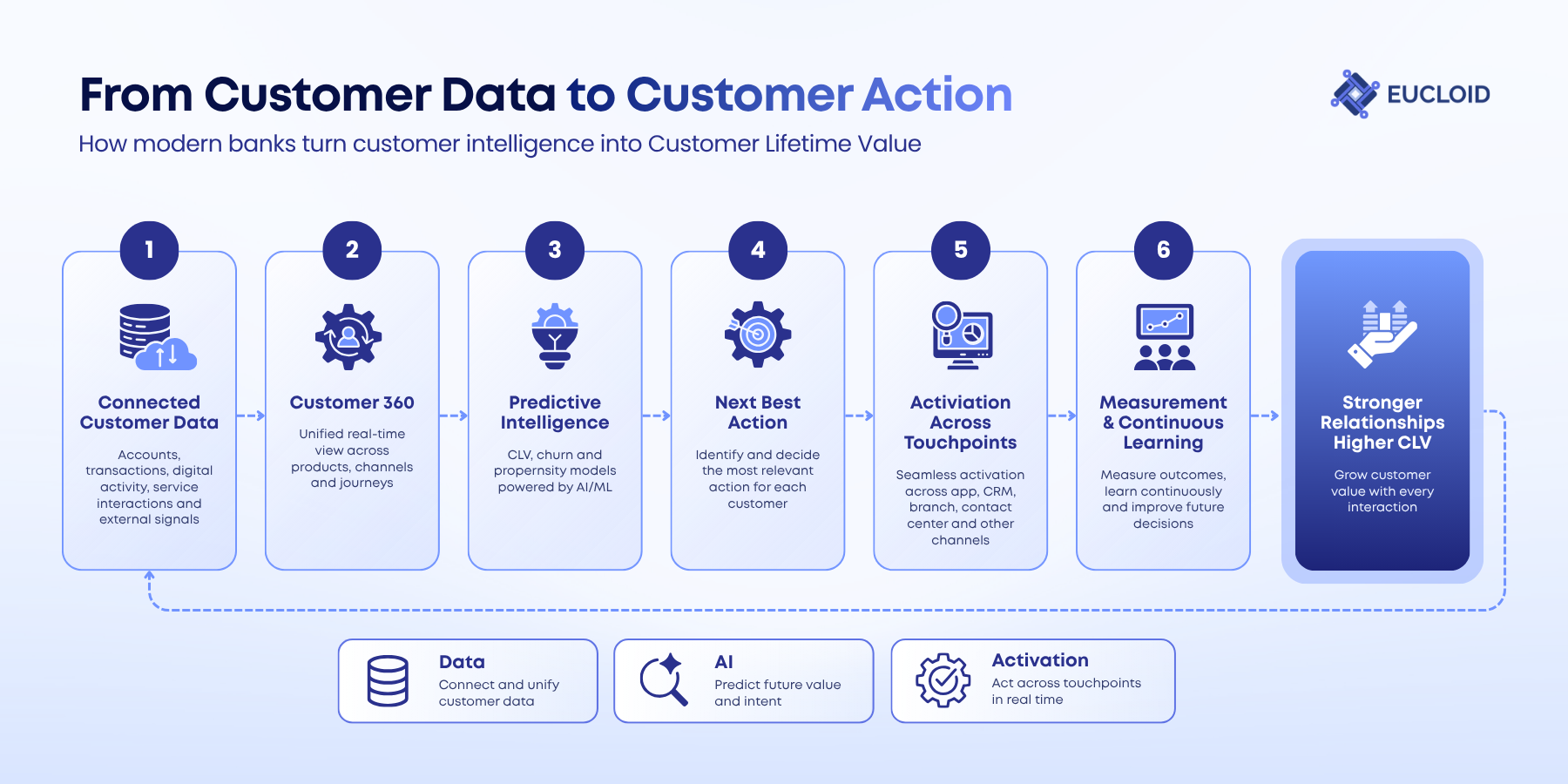
Now, a recommendation engine, a servicing application and an AI assistant can evaluate the same customer from the same information, in simple words, reduction in data duplication.
Customer Experience Is Becoming A Stronger Driver Of Retention
Customer experience is becoming one of the strongest predictors of long-term banking relationships. As customers become more willing to compare providers before opening new accounts or applying for loans, every interaction has greater influence over whether the relationship continues to grow.
Banks are also changing how those experiences are delivered. Mobile banking, contact centers, relationship managers, self-service portals and branch interactions are increasingly expected to work as one continuous journey rather than as independent service channels. Besides, customers increasingly expect consistent experiences regardless of how they choose to engage with their bank, while banks continue investing in digital servicing, personalization and omnichannel engagement to meet those expectations.
Ultimately, these shifts are changing how Customer Lifetime Value is built.
Customer Value Is Built Continuously
Banks have traditionally measured Customer Lifetime Value after customer behaviour had already taken place.
Marketing teams calculate it, finance teams report it, and business teams use it to evaluate growth over time. Increasingly, however, Customer Lifetime Value depends on decisions that happen long before those reports are produced.
Consider a customer who receives their salary through one account, uses a credit card regularly, applies for a home loan, contacts customer support, and later begins investing. Individually, these interactions belong to different systems and different business functions. Collectively, they represent a single customer relationship.
As banks look to identify the next financial need, predict attrition, or personalize engagement, historical reporting is no longer sufficient. Customer Lifetime Value increasingly depends on connecting customer activity as it happens rather than reconstructing it weeks or months later.
Recent advances in enterprise data platforms are reducing this distinction between operational databases and analytical systems. Instead of moving customer data through multiple layers before it becomes usable, banks are beginning to work from a shared platform designed to support everything from the same data foundation, reducing the delay between customer activity and business response.
Rather than relying on periodic extracts from individual business systems, they're bringing together customer events from core banking platforms, card processors, loan servicing applications, CRM systems, digital banking channels, and contact centers into a single governed data environment. That makes it possible to evaluate customer relationships using the latest account activity, servicing history, transaction behavior, and product usage, rather than relying on historical snapshots.
Once those data sources operate on a common customer identity, CLV can support decisions beyond reporting. Banks can identify customers whose transaction patterns indicate a growing borrowing need, detect early signs of relationship attrition before accounts are closed, prioritize high-value customers during servicing, or trigger personalized product offers based on changes in financial behavior—all from the same customer context instead of multiple disconnected systems.
What’s Next?
Most banks still calculate Customer Lifetime Value after customer activity has already occurred. The next generation of banking platforms will invert that model.
Traditionally, customer value has been measured in days, weeks, or months. As banks adopt streaming data architectures and operational analytics, that feedback loop is shrinking to minutes—or even seconds. Rather than describing what a customer was worth last quarter, it becomes a live operational signal that reflects the current state of the relationship. The institutions building for that future are unlikely to measure CLV less often; they'll measure it every time the customer relationship changes.
At Eucloid, we've been helping financial institutions modernize their data foundations to support customer-centric decision-making. Get in touch with our team to discuss your own modernization journey.