
Healthcare's digital front door has expanded rapidly.
Patients now discover providers, compare treatments, schedule appointments, complete intake forms, access patient portals, attend virtual consultations, and pay bills through digital channels. Every such interaction generates behavioral data that helps healthcare organizations understand patient journeys, improve digital experiences, and support better engagement across the continuum of care. And it's no surprise that around 70% of health system executives expect digital front door initiatives to deliver the highest impact among digital investments.
Google Analytics 4 (GA4) has become one of the most widely used platforms for measuring this digital activity, offering rich insights into traffic sources, user behavior, engagement, and conversions. Its relatively easy implementation, combined with native integration with Google Ads and the wider Google marketing ecosystem, makes it easy to connect campaigns, traffic, audiences, and conversions. These integrations also provide powerful marketing attribution capabilities, helping teams link digital spend to outcomes.
However, in healthcare, measuring user behavior introduces a different set of considerations. Unlike retail or media websites, healthcare digital properties routinely handle information that may qualify as Protected Health Information (PHI), placing analytics implementations under HIPAA scrutiny.
This has led many organizations to ask whether Google Analytics 4 can be configured to meet HIPAA requirements. Common approaches include disabling Google Signals, limiting data retention, masking identifiers, or implementing cookie consent banners.
The challenge, however, is not just how GA4 is configured. It is whether PHI can be transmitted to a third-party analytics platform in the first place. As healthcare organizations continue to invest in digital patient experiences, decisions around browser-side versus server-side collection, first-party event pipelines, data governance, vendor agreements, and PHI validation now play a central role in designing modern healthcare analytics architecture.
Understanding that distinction is key to designing a measurement environment that preserves digital visibility without exposing sensitive healthcare data.
The HIPAA Requirements Google Analytics 4 Cannot Meet
One of the fundamental requirements under HIPAA is the Business Associate Agreement (BAA). A BAA is a legally binding contract required when a third-party service creates, receives, maintains, or transmits PHI on behalf of a covered entity or business associate. It establishes each party's responsibilities for safeguarding PHI and is a prerequisite for using third-party services in HIPAA-regulated workflows.
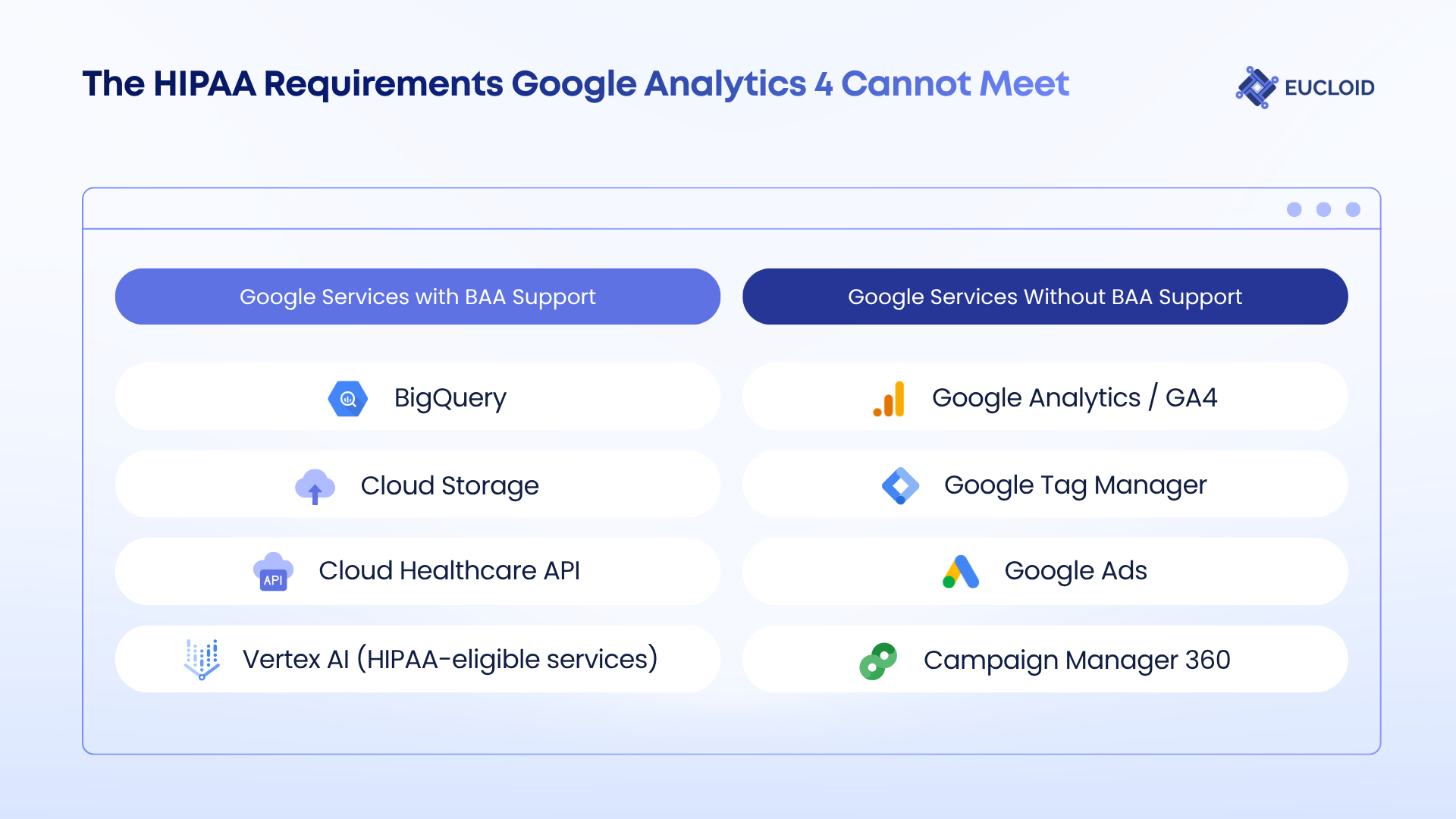
Google offers BAAs for several Google Cloud services, including BigQuery, Cloud Storage, and the Cloud Healthcare API, enabling healthcare organizations to build data platforms that support HIPAA-regulated workloads. However, Google Analytics 4 is not included in Google's list of HIPAA-eligible services, and Google does not offer a BAA for GA4. Google also states that it makes no representation that Google Analytics satisfies HIPAA requirements and advises customers against sending information subject to HIPAA to the platform.
Product configuration alone cannot address this requirement. Privacy-focused settings such as disabling Google Signals, adjusting data retention periods, masking identifiers, or implementing cookie consent banners may reduce data collection or strengthen privacy controls, but they do not change the contractual relationship between the healthcare organization and Google. Without a BAA, there is no HIPAA-compliant basis for transmitting PHI to Google Analytics 4.
Understanding PHI Exposure in Web Analytics
The next question begins with 'how PHI reaches analytics platforms in the first place?' This is where the compliance risks start to appear.
In many cases, organizations do not intentionally send Protected Health Information (PHI) to analytics platforms. More often, it is introduced through standard browser behavior, application design, and analytics implementations that were never designed to handle regulated healthcare data.
The biggest misconception we see in healthcare analytics is that PHI exposure happens only when someone explicitly passes a patient name or medical record number. In reality, it can happen through the combination of a URL, page context, event parameter, identifier, or even a search term. That’s why a HIPAA-compliant implementation has to start at the event-collection layer and not with a privacy setting inside the analytics tool.
Udisha Agrawal | Senior Director- Delivery, Eucloid Data Solutions
Each webpage visit generates an analytics request containing metadata such as the page URL, page title, referrer, client and session identifiers, browser information, and timestamps. Depending on the implementation, it may also include custom event parameters, ecommerce data, or variables passed through Google Tag Manager.
The problem begins here.
Unlike transactional systems, analytics platforms do not distinguish between business data and healthcare data. They process the event payload exactly as it is received. However, on healthcare websites, these data points require additional scrutiny because they can contain or reveal Protected Health Information (PHI). While a page view alone is not PHI, it may become PHI when combined with identifiers or when it relates to an individual's past, present, or future health condition, treatment, or payment for healthcare services. Eventually those values become part of the analytics request unless they are removed before transmission.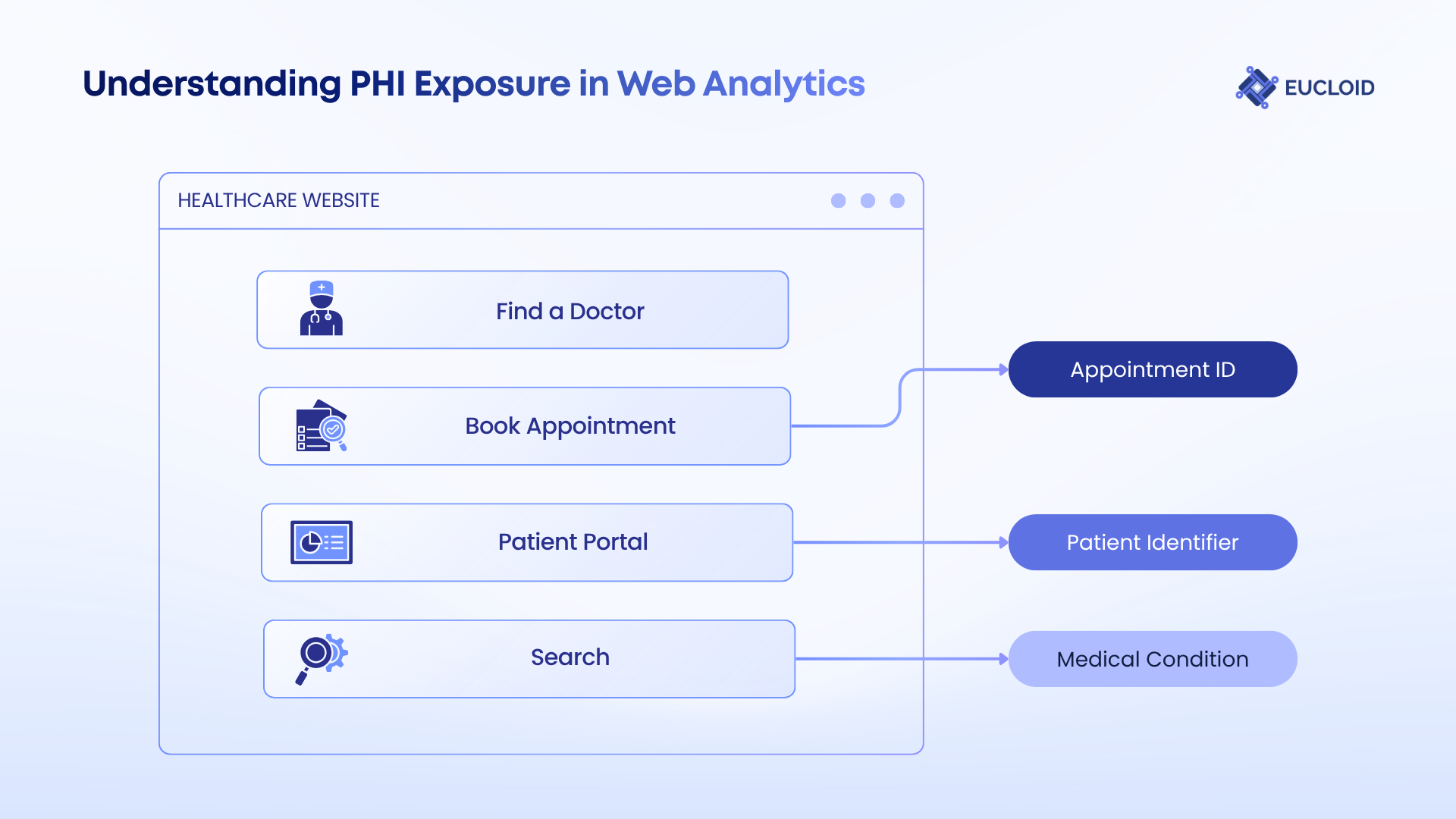 Google Analytics 4 Enhanced Measurement features automatically collects events such as page views, site search, file downloads, outbound clicks, and scroll tracking. On appointment booking pages, patient portals, intake forms, telehealth applications, and other healthcare workflows, these configurations should be reviewed to ensure event payloads do not include or expose Protected Health Information (PHI) before being transmitted to downstream platforms.
Building a HIPAA-Conscious Analytics Architecture
A HIPAA-conscious analytics architecture focuses on controlling where data is collected, how it is processed, and what information is allowed to leave the application. Rather than sending browser events directly to third-party analytics platforms, healthcare organizations can introduce governance controls that validate event data before transmission.
Separate Marketing and Patient-Facing Experiences
Healthcare websites typically contain a mix of public and authenticated experiences, but they should not be treated as a single analytics environment. Marketing pages, provider directories, blogs, and educational content generally carry lower compliance risk. On the contrary, appointment scheduling, patient portals, intake forms, telehealth, prescription management, and laboratory results should follow a separate measurement strategy with stricter controls over what data is collected and where it is transmitted.
Introduce a First-Party Collection Layer
Traditional web analytics sends browser events directly to an analytics platform for processing. A healthcare analytics architecture introduces a governed event pipeline between data collection and data activation.
So, instead of transmitting browser events directly to third-party platforms, organizations can route events through a first-party collection endpoint, ensuring event payloads are validated before they are shared with downstream systems. This layer can be used to
- Remove patient identifiers and sensitive parameters
- Standardize event names and schemas
- Enforce approved data collection policies
- Reject events that do not meet governance requirements
Centralize Analytics in a Governed Data Platform
Validated event data should then be stored within a governed data platform before it is distributed to reporting or activation tools. Platforms such as Databricks and BigQuery provide centralized governance through role-based access control, audit logging, data lineage, encryption, and fine-grained security policies.
This provides a single source of truth for digital interactions while enabling role-based access, audit logging, data lineage, and consistent governance across analytics, reporting, and AI workloads.
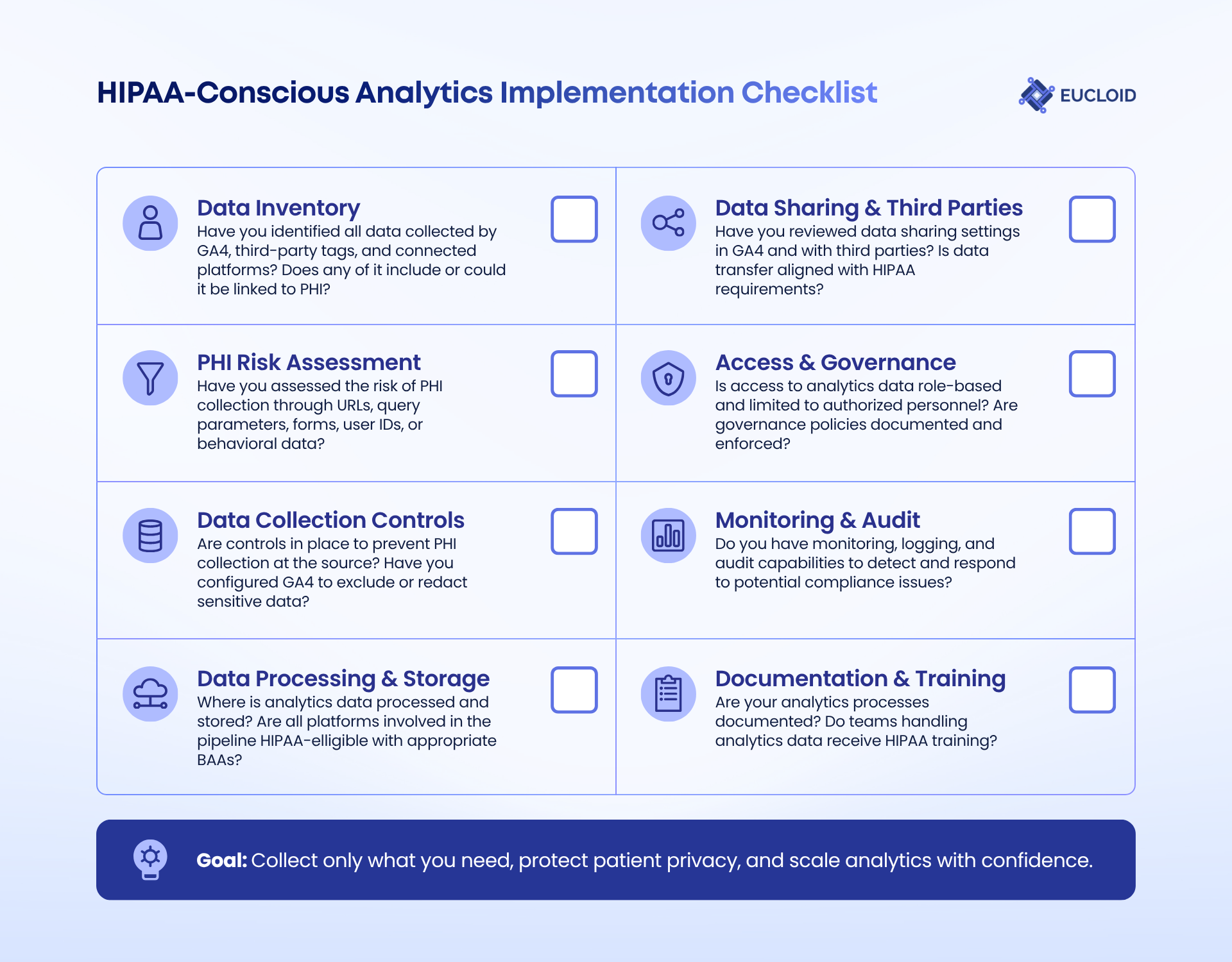
Activate Only Approved Data
Analytics platforms, advertising tools, and customer engagement platforms do not always require the same level of detail. Once events have been validated and governed, organizations can selectively share approved datasets with downstream systems based on intended business purpose.
For example, website engagement metrics can be shared with Google Analytics 4 for performance reporting, while patient-related data remains within the organization's governed data platform. This approach supports digital measurement without transmitting sensitive healthcare information to non-HIPAA-eligible services.
Implement a Dual-Platform Analytics Model
Some healthcare organizations use a dual-platform setup when they need both marketing analytics and detailed analysis of patient-facing experiences. It means that GA4 can remain on pages that are outside the HIPAA-covered scope, while a separate analytics platform that will sign a BAA can capture detailed events from PHI-sensitive workflows such as appointment scheduling, intake, portals, or other workflows where PHI may be present.
Google itself states that HIPAA-regulated organizations should not use GA4 on HIPAA-covered pages, including authenticated pages.
The two platforms can serve different measurement needs: GA4 for acquisition and marketing performance, and the BAA-covered platform for granular patient journey analytics such as form progression, navigation, and conversion steps. Simply put, the second platform is not a replacement for GA4 but can retain the event-level detail needed to understand where users drop off in an appointment flow, which steps create friction, how patients navigate a portal, or how digital services are being adopted.
This gives healthcare organizations a way to retain GA4 for appropriate marketing measurement while using a BAA-covered platform for the detailed analytics required across patient-facing experiences.
And, this model is already supported by analytics vendors that offer healthcare-specific deployments and BAA arrangements.
Takeaway
Google Analytics 4 can continue to play a role in healthcare analytics, but only as part of a broader, HIPAA-conscious analytics architecture.
At Eucloid, we partner with healthcare organizations to assess Google Analytics 4 implementations, design HIPAA-conscious measurement architectures, and build governed analytics platforms on Databricks that support enterprise-scale digital analytics.